
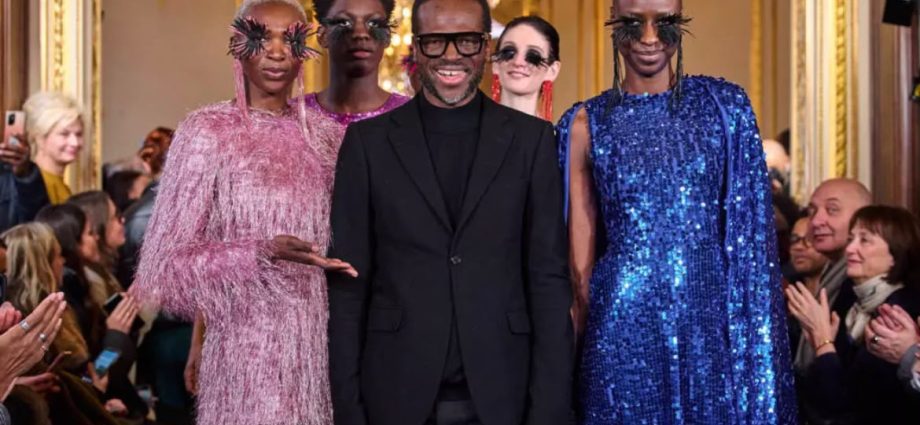
From his first designs shown in Paris in the early 1990s to his inclusion in the official Haute Couture calendar in 2020, Imane Ayissi has forged a unique path spanning Cameroon and Paris. A former dancer and model, the Cameroonian designer creates fashion where African craftsmanship—such as raffia, ndop, kente, and faso dan fani—engages in a dialogue with the codes of Parisian couture.
From Yaoundé to Paris: Before the Runways

Before becoming one of the African names associated with Parisian Haute Couture, Imane Ayissi lived several artistic lives. Born in Cameroon, he first pursued dance—notably with the National Ballet of Cameroon—before moving into modeling. After settling in France, he worked for major international fashion houses, gaining firsthand insight into the demands of garment making, the body, and silhouette construction.
However, his connection to fashion began long before his arrival in Europe. His mother, Julienne Honorine Eyenga Ayissi—the first Miss Cameroon following the country’s independence—played a pivotal role in shaping his aesthetic sensibility. As a young boy, Imane would take apart her clothes to understand how they were constructed.
This hands-on approach would remain a hallmark of his career. Imane Ayissi is a self-taught designer; he learns by observing, experimenting, and working directly with the materials.
1992: The First Steps of a Self-Taught Designer
His creative journey did not begin with the official founding of his fashion house in 2004. In an interview with Le Monde, Ayissi recounted presenting his first collection in Paris in 1992.
It was an experience rooted in artisanal craftsmanship. He explains that he bought fabrics at the Marché Saint-Pierre and created a collection of 120 polka-dot dresses. Far from being an overnight success story, this period marked the beginning of a long process of professional development.
For several years, the designer worked on other projects alongside his own creations. He produced pieces for private clients while gradually developing his own distinctive approach to tailoring and cut.
This consistency would become a hallmark of his career; Ayissi told Le Monde that he has presented a collection every year since he started out.
A new milestone was reached in 2004 with the official founding of Maison Imane Ayissi. The Fédération de la Haute Couture et de la Mode now recognizes this year as the official date of the House’s inception.
Couture that rejects clichés about Africa
One of the distinctive features of Imane Ayissi’s work lies in how he approaches the concept of African fashion.
The designer refuses to reduce the continent to a single aesthetic. For him, Africa is not a homogeneous cultural market, but a diverse array of territories, languages, traditions, and forms of craftsmanship.
This stance is clearly reflected in his collections.
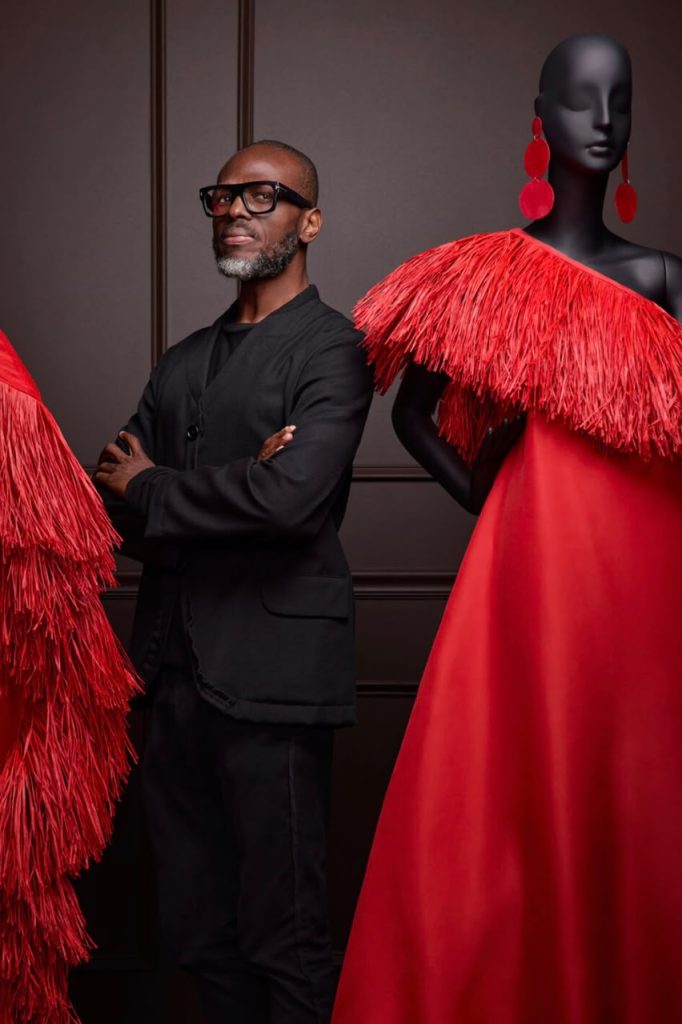
The designer works with materials and textiles from various regions across the continent: Cameroonian ndop, raffia, Ghanaian kente, faso dan fani from Burkina Faso, and obom—a material derived from Cameroonian tree bark.
Wax print—often viewed as a global symbol of contemporary African fashion—does not hold the same place in his design vocabulary. Ayissi explains that he wants to move beyond the notion that African sartorial identity can be summed up by colorful prints.
His approach focuses instead on seeking out lesser-known textile techniques and integrating them into contemporary couture designs.
This approach lends a Pan-African dimension to his work. Cameroon is his home territory, yet his creative language draws from various regions across the continent.
The meeting of African craftsmanship and Parisian couture
Imane Ayissi’s project is not simply about applying African textiles to Western silhouettes.
The true focus lies in the transformation of the material itself.
A hand-woven fabric can be transformed into a structured jacket. Raffia can be crafted into fringes or decorative elements. Kente cloth can be incorporated into the construction of a coat or dress. Ndop fabric can be integrated into silhouettes designed to meet the exacting standards of couture.
This approach allows the textile to retain part of its identity while shifting into a new aesthetic context.
It is precisely this intersection of heritage and contemporary construction that defines the House’s signature style.
As recently as 2025, the FHCM described his work as a blend of African heritage, Parisian flair, and artisanal craftsmanship.
The turning point of 2020
The most widely documented moment in Imane Ayissi’s international career occurred in January 2020.
The Fe