
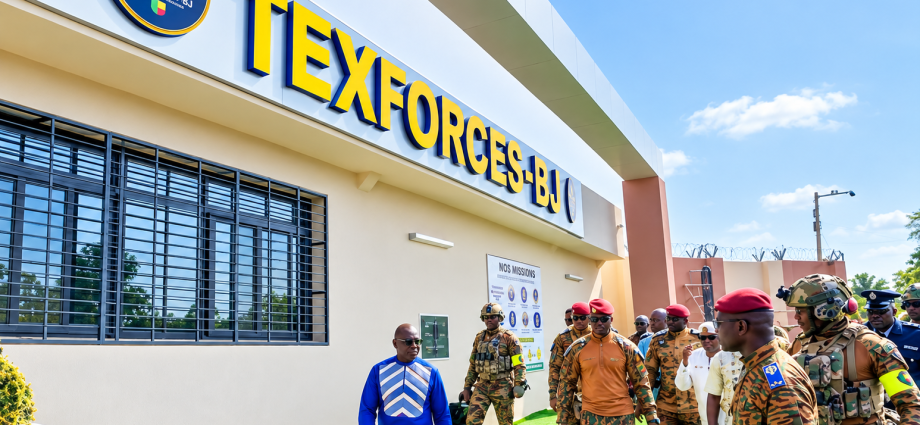
Burkina Faso inaugurated the TEXFORCES-BF complex in Bobo-Dioulasso on September 9, a fully integrated textile facility costing 17 billion CFA francs (30 million dollars) and built to supply uniforms for the country’s defense and security forces while also serving the civilian clothing market. The plant is designed to process more than 12 tonnes of raw cotton fiber a day, covering everything from weaving to garment finishing. For a country that ranks among Africa’s top cotton producers but has long struggled to build local processing capacity, this launch signals something bigger than a government contract.
Twelve tonnes of raw cotton fiber a day. That’s the initial processing capacity announced for the Textile Industrial Complex of the Forces of Burkina Faso (TEXFORCES-BF), inaugurated on September 9 in Bobo-Dioulasso by President Ibrahim Traoré. Built on a 30-hectare site in Logofourousso, the complex represents a total investment of 17 billion CFA francs, or roughly 30 million dollars.
The plant was designed as a fully integrated operation: weaving, knitting, dyeing-finishing, and garment assembly all sit on the same site. That structure matters. It means fiber enters at one end of the chain and finished clothing comes out the other, with no need to outsource any stage abroad — a setup still uncommon in the subregion, where cotton processing often stops at ginning.
A Government Order as an Industrial Foundation
TEXFORCES-BF’s first mandate is producing uniforms for the Defense and Security Forces and for the Volunteers for the Defense of the Homeland. But the plant is also positioned to supply the civilian clothing market.
The projected volumes give a sense of scale. According to a statement published on the government’s website, the unit is expected to produce 20 million meters of fabric, 6 million units of knitwear, 6 million uniforms, 6 million t-shirts, and 1 million pairs of socks annually. The authorities did not specify the unit of measure behind the “6 million knitwear” figure.
This structure — a guaranteed public order paired with a commercial opening — follows a familiar pattern for industrial ramp-up. The institutional contract secures line utilization during the startup phase; the civilian market will then determine whether the plant finds a sustainable business model on its own.
A Denser Industrial Fabric
TEXFORCES-BF is not a standalone initiative. It’s part of a broader sequence of investments aimed at strengthening Burkina Faso’s cotton-processing capacity, underway for several years now.
In November 2025, the government had already inaugurated the National Center for Support to Artisanal Cotton Processing (CNATAC) in Bobo-Dioulasso. Built with a budget of 1.5 billion CFA francs, the center is equipped for weaving, dyeing, and sewing, and is meant to build the skills of artisanal processing actors. Two complementary scales are thus taking shape around Bobo-Dioulasso: heavy industry on one side, artisanal know-how on the other.
Private capital is following suit. In July 2025, the Caisse des Dépôts et d’Investissements du Burkina Faso (CDI-BF) and Kenya’s Basra Textile Mills signed a memorandum of understanding to set up an integrated textile unit in the country. The planned investment is around 25 million dollars and could take the form of a public-private partnership. The arrival of an East African operator in a West African textile market is itself telling — it suggests the Burkinabè sector is starting to be read as an industrial asset, not merely a source of raw material.
Upstream, the raw material base is also being mobilized. For the 2026/2027 season, authorities are targeting seed cotton production of 532,000 tonnes, a nearly 69% increase over the previous season.
The Import Equation
The decisive question remains: at what scale will these new capacities actually operate?
Data from Burkina Faso’s National Institute of Statistics and Demography (INSD) sets the baseline. Between 2019 and 2023, the country imported an average of nearly 38,946 tonnes of clothing and clothing accessories per year, at an annual cost of roughly 18.65 billion CFA francs.
That figure cuts both ways. It measures the country’s current dependence on foreign textile products, and it also outlines the addressable market for the new production units. Set against that annual import bill, the 17-billion-CFA-franc investment in TEXFORCES-BF looks more modest in scale — it amounts to less than one year’s worth of clothing imports.
What This Means for the Industry
The push underway in Bobo-Dioulasso is shifting the center of gravity of Burkina Faso’s cotton sector. A country that sells raw fiber captures only a fraction of the value; a country that weaves, dyes, and sews captures the bulk of it, while also creating skilled jobs and building a subcontracting base.
That is precisely the ambition behind Burkina Faso’s textile push: moving from a model centered on raw cotton production toward a chain that generates more value locally.
The real test will come with operations — steady fiber supply, finishing quality, price competitiveness against imports, and workforce training. For African fashion, which still lacks industrial-scale production capacity on the continent, the success or failure of this Burkinabè push carries implications well beyond the country’s borders.