
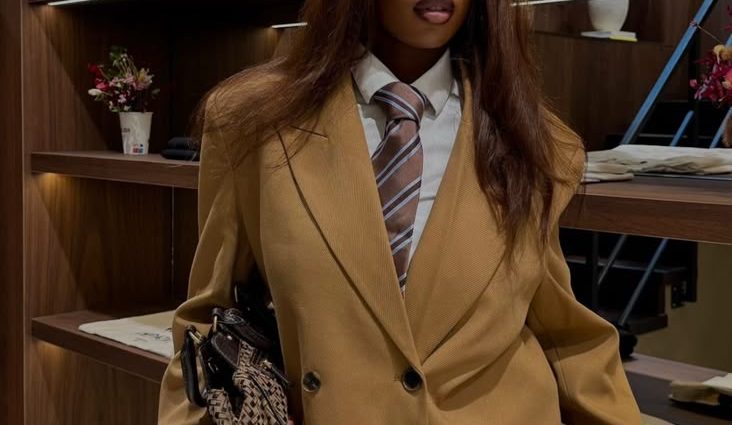
The suit is back. But it isn’t coming back quite the way it was.
For several seasons now, silhouettes have been breaking free of overly fitted cuts in favor of more generous volumes. Jackets with strong shoulders, wide trousers, long jackets and deconstructed silhouettes: oversized tailoring is gradually establishing itself in the contemporary fashion landscape.
From the runway to street style, the suit is leaving the strict codes of the office to become a true style piece. But behind this return of volume lies an older story and a profound shift in our relationship with clothing.
A trend that isn’t new
Oversize is not an invention of today’s fashion.
Roomy silhouettes have already marked several decades of fashion history, notably the 1980s, with structured shoulders and suits associated with power and professional success. The 1990s then popularized more relaxed silhouettes, in which loose jackets and baggy trousers accompanied the rise of streetwear and a new idea of the male wardrobe.
Today, these influences are returning, but they are being reinterpreted.
The contemporary suit no longer necessarily seeks to follow the contours of the body perfectly. It plays with proportion, movement and volume.
Why is tailoring coming back now?
The return of tailoring comes after several years in which comfort and sportswear profoundly transformed the way we dress.
Joggers, sneakers, hoodies and athleisure silhouettes blurred the boundaries between city clothes, work clothes and leisure clothes.
Tailoring therefore returns with a new proposition: rediscovering structure without giving up comfort.
The oversized jacket answers this shift perfectly. It keeps the codes of the suit (lapels, shoulders, construction, buttoning) while offering more freedom. The suit is no longer solely associated with authority or the professional world. It becomes a tool for building a silhouette.
More than a garment: a question of proportions
Recognizing oversized tailoring is, above all, a matter of observing proportions.
The jacket may be longer, wider or have more pronounced shoulders. Trousers gradually abandon very fitted cuts in favor of straight or wide legs, sometimes with pleats and a high waist.
But beware: oversize doesn’t simply mean “too big.”
The volume is considered, constructed and controlled.
A roomy jacket worn with wide trousers produces a spectacular silhouette. Conversely, an oversized jacket paired with a closer-fitting piece creates a contrast that lets you tame the trend more subtly.
It is this freedom in proportions that gives tailoring its strength today.
From the office to the street
One of the most interesting developments is the suit’s gradual departure from its traditional territory.
The blazer can now be worn with a simple T-shirt, a tank top, jeans or a pair of sneakers. Suit trousers can be paired with a casual shirt, loafers or sportier shoes.
The suit is no longer necessarily a complete outfit.
It becomes a piece that you deconstruct, mix and reinterpret.
This shift is part of a broader transformation of contemporary fashion: the boundaries between formalwear, casualwear, streetwear and sportswear are becoming less and less rigid.
And what about Africa?
This is where the phenomenon takes on a particularly interesting dimension.
Africa is not discovering the voluminous garment today.
In many African clothing cultures, volume has a long history. The agbada, the boubou and various forms of loose garments bear witness to traditions in which clothing does not necessarily seek to hug the body.
Volume can be aesthetic, ceremonial, statutory or cultural.
In Lagos, Accra, Johannesburg and other major African creative capitals, contemporary tailoring thus evolves in an environment where bespoke, the suit and loose garments have long coexisted.
The interest of oversized tailoring for African fashion therefore lies not simply in adopting a trend from international runways.
It lies in the possibility of bringing the contemporary codes of the suit into dialogue with an African culture of volume, textiles and artisanal know-how.
When tailoring meets African craftsmanship
This encounter opens up many creative possibilities. An oversized blazer can be made from a locally woven textile. Wide trousers can be crafted from a traditional fabric. A suit silhouette can borrow certain proportions from an African garment without trying to reproduce it literally.
Indigo, Faso Dan Fani, kente, aso-oke or bogolan can thus become fields of experimentation for designers, provided they respect their history, origin and cultural significance.
The goal is not simply to add “an African touch” to the suit.
It is rather to create a genuine conversation between cut, material, craftsmanship and identity.
Volume as a new language of elegance
The success of oversized tailoring ultimately reveals something deeper: our conception of elegance is evolving.
For a long time, an elegant silhouette was often associated with the precision of a fitted cut.
Today, elegance can also reside in fullness, movement and mastery of volume.
Clothing no longer necessarily needs to emphasize the body to assert a presence.
It can also create a silhouette around it.
This may be where the real evolution of contemporary tailoring lies: the suit isn’t disappearing, it’s changing its language.
Afrikashion’s take
Oversized tailoring can hardly be reduced to a mere micro-trend born on social media.
Its return is part of a broader evolution of the contemporary wardrobe: the return of tailoring, wide trousers, the pursuit of comfort, the blurring of masculine and feminine codes, and the reinterpretation of the suit outside the professional setting.
How long it will last, however, remains to be seen.
Volumes will probably keep evolving from season to season. Some very roomy silhouettes may gradually give way to more balanced proportions.
But one thing already seems certain: the contemporary suit has rediscovered a taste for volume.
And in Africa, this evolution could take a particularly interesting direction.
Because when international tailoring meets African cultures of loose clothing, textiles and bespoke craftsmanship, volume is no longer just a trend.
It becomes a field of creation, identity and innovation.
Oversized tailoring therefore doesn’t merely ask, “What size should I wear?”
It poses a more interesting question:
how far can we push proportions to reinvent elegance?