
For a long time, dressing meant having one’s clothes made by a tailor or a dressmaker, or making them oneself. In the 19th century, industrialization gradually disrupted this model. The sewing machine, mass production, size standardization, department stores, and mail-order catalogs transformed how clothes were made and purchased. Ready-to-wear was not born from a single invention, but from the intersection of technology, industry, commerce, and new lifestyles.
Before Ready-to-Wear, Clothing Was Above All a Personal Matter
Today, walking into a shop and choosing a pair of pants, a jacket, or a dress from several sizes seems natural. Yet, this possibility is relatively recent in the history of clothing.
For much of Western history, a garment was made for a specific individual. Clients turned to a tailor, a dressmaker, or a workshop, who took their measurements before cutting and assembling the fabric. People with fewer means could also make their own clothes.
Clothing was therefore not merely an object one bought: it was the result of a personalized manufacturing process.
The system we call ready-to-wear today relies on a radically different logic: manufacturing multiple copies of the same model according to standardized sizes, then offering them for sale even before knowing who the buyer will be.
The Metropolitan Museum of Art defines this distinction precisely: haute couture relies on garments made for a specific individual, whereas ready-to-wear is produced in multiple copies and standardized sizes intended for a broader market.
But how did we get here?
1. AT THE ORIGINS: WHEN CLOTHING STARTED BEING MADE FOR A MARKET
The idea of “ready-to-sell” clothing is older than the modern term ready-to-wear.
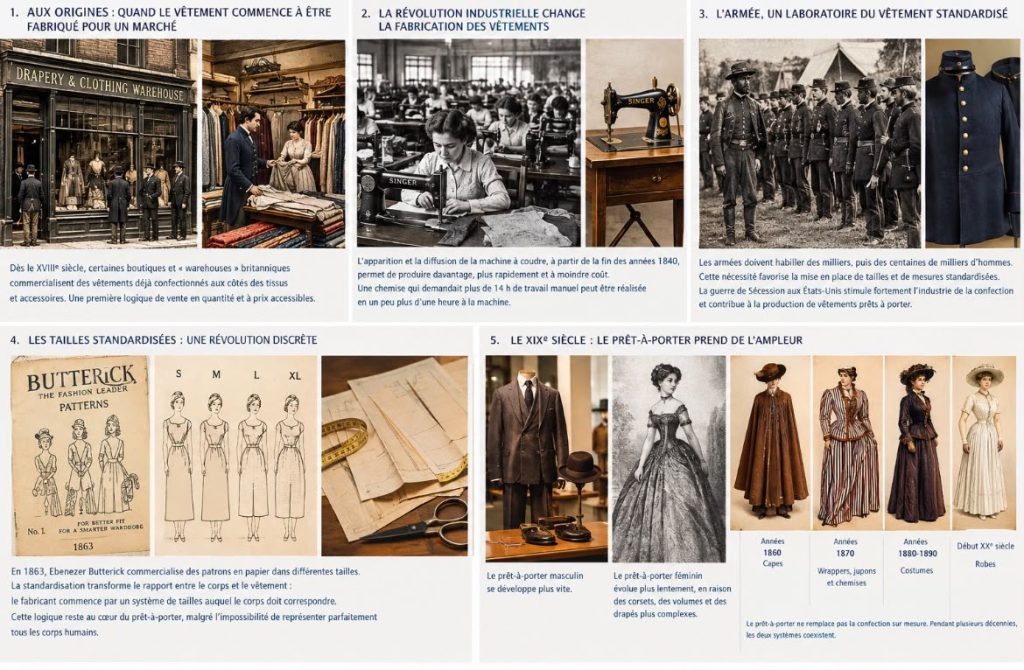
As early as the 18th century, certain British shops and “warehouses” marketed pre-made garments alongside fabrics and accessories. These establishments operated under a new logic: offering merchandise in volume, with regular stock replenishment and relatively accessible prices.
However, this was not yet the ready-to-wear industry as we know it today.
The major transformation came with the Industrial Revolution.
Starting in the late 18th century and particularly throughout the 19th century, production techniques evolved rapidly. Cities grew, transport expanded, urban populations increased, and a new middle class emerged.
These changes gradually created the necessary conditions for a new clothing economy.
2. THE INDUSTRIAL REVOLUTION CHANGES CLOTHING MANUFACTURING
Ready-to-wear is inseparable from industrialization.
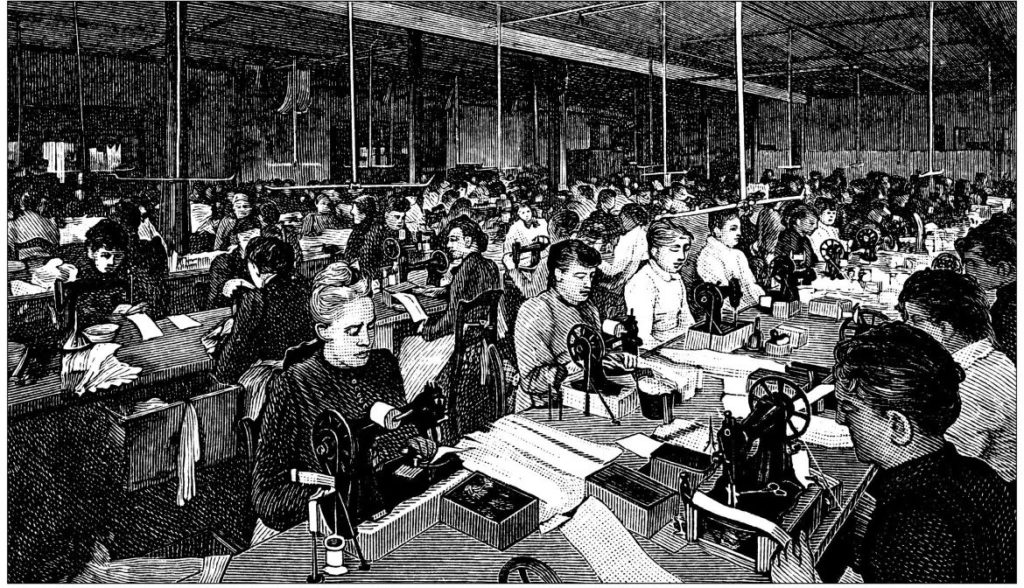
Previously, garment making depended heavily on manual labor. Each piece required time and a significant amount of work.
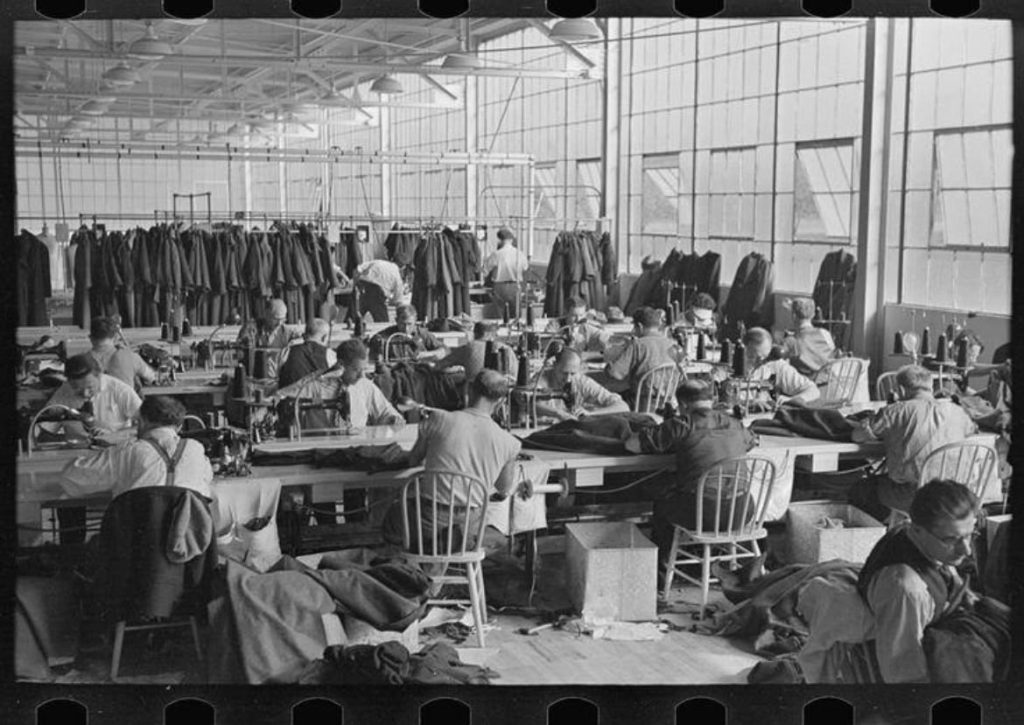
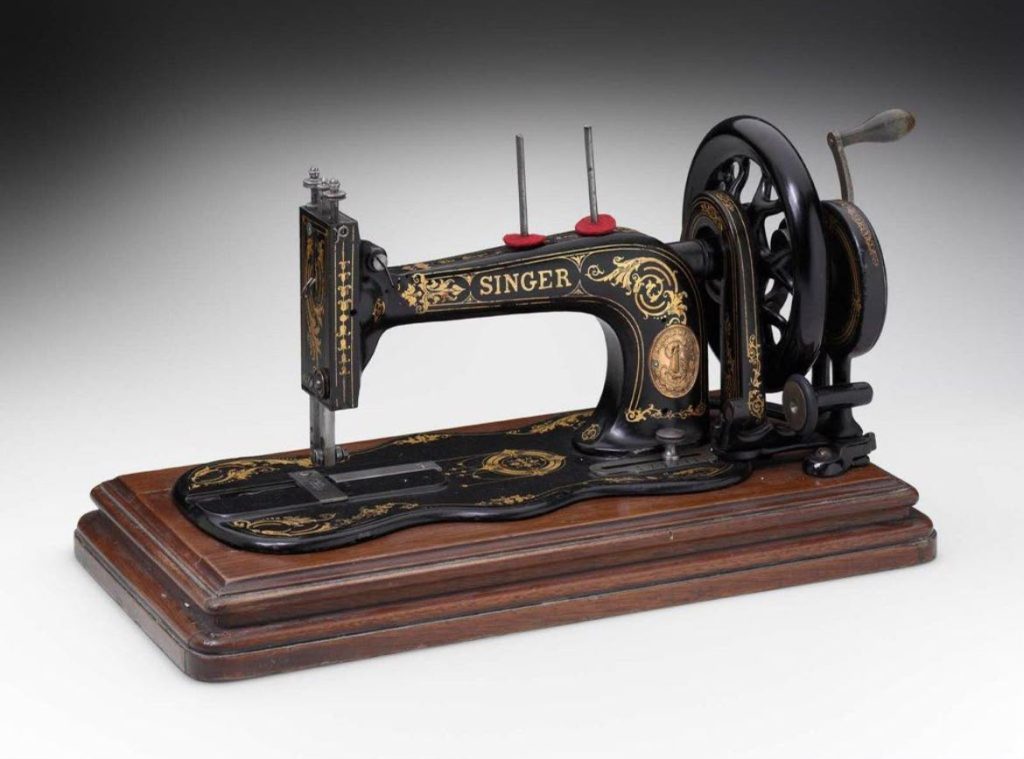
The emergence and spread of the sewing machine profoundly changed the situation.
Commercially available starting in the late 1840s, it significantly reduced the time needed to make many garments. According to historical data compiled by the Fashion Institute of Technology, a men’s shirt that could take more than fourteen hours of handwork could be completed in just over an hour by machine. A coat that required nearly seventeen hours could be made in about two and a half hours.
The machine did not immediately replace the skill of the tailor or dressmaker.
Above all, it allowed for producing more, faster, and at a lower cost.
This evolution was fundamental: for the first time, clothing manufacturing could truly be organized along industrial principles.
3. THE ARMY: A LABORATORY FOR STANDARDIZED CLOTHING
Another decisive factor emerged in the manufacturing of military uniforms.
Armies had to clothe thousands, then hundreds of thousands of men in garments capable of fitting different bodies.
It became impossible to take the individual measurements of every soldier and make each uniform as a unique piece.
Military production thus contributed to the development of standardized size and measurement systems.
This evolution was particularly significant in the United States during the 19th century, where military needs strongly stimulated the garment industry.
The American Civil War in particular created a massive demand for ready-made uniforms and contributed to the expansion of industrial garment production.
Clothing gradually became a product that could be classified, measured, cut, and produced according to standards.
This was one of the technical foundations of future ready-to-wear.
4. STANDARDIZED SIZES: A DISCREET REVOLUTION
Mass production was not enough.
An essential question also had to be solved:
How do you manufacture a garment without knowing in advance the body of the person who will wear it?
The answer lay in sizes.
In the 19th century, measurement systems and standardized patterns advanced. In 1863, Ebenezer Butterick commercialized paper patterns in different sizes. This innovation allowed individuals to replicate garments at home more easily.
Standardization thus gradually transformed the relationship between the body and the garment.
Instead of starting with the individual to determine the garment, the manufacturer started with a sizing system to which the body had to fit.
This industrial logic remains at the heart of contemporary ready-to-wear.
It carries, however, a fundamental limitation: no standardized sizing system can perfectly reflect the diversity of human bodies.
This issue of fit, already present in the 19th century, remains one of the great challenges of ready-to-wear today.
5. THE 19TH CENTURY: READY-TO-WEAR GAINS MOMENTUM
In the mid-19th century, the market for ready-made clothing grew rapidly.
Men’s ready-to-wear developed faster than women’s.
The reason was partly related to garment construction. Men’s clothing—particularly suits, coats, and shirts—could more easily be produced according to standardized proportions.
Women’s fashion remained more dependent on the body and silhouette.
Corsets, complex volumes, draping, and fittings made industrial manufacturing more difficult.
Women’s ready-to-wear therefore emerged gradually.
Simpler garments were the first affected: outerwear, capes, undergarments, and other pieces that were relatively easy to mass-produce.
According to the Fashion Institute of Technology, women’s ready-to-wear developed progressively: capes in the 1860s, wrappers, petticoats, and shirts in the 1870s, suits in the 1880s–1890s, and dresses in the early 20th century.
Ready-to-wear did not abruptly replace custom tailoring.
For several decades, both systems coexisted.
6. DEPARTMENT STORES: THE NEW TEMPLES OF CLOTHING
The history of ready-to-wear is also the history of a retail transformation.
The 19th century saw the arrival of department stores.
In Paris, London, New York, and other major cities, these new spaces offered fabrics, clothing, accessories, and consumer goods under one roof.
Le Bon Marché, founded in Paris in 1852, served as one of the major models for this new form of commerce. In the United States, stores like A.T. Stewart, Lord & Taylor, and Macy’s also contributed to the evolution of modern retail.
The department store changed consumer behavior.
People no longer came merely to buy what they needed.
They came to browse, compare, try on, choose, and sometimes simply discover what was new.
Industrialization, urbanization, transportation, and mass production thus combined with new retail spaces to accelerate the spread of ready-made clothing.
Fashion gradually began to become a true mass market.
7. CATALOGS AND MAIL ORDER EXPAND THE MARKET
Ready-to-wear soon no longer depended solely on physical shops.
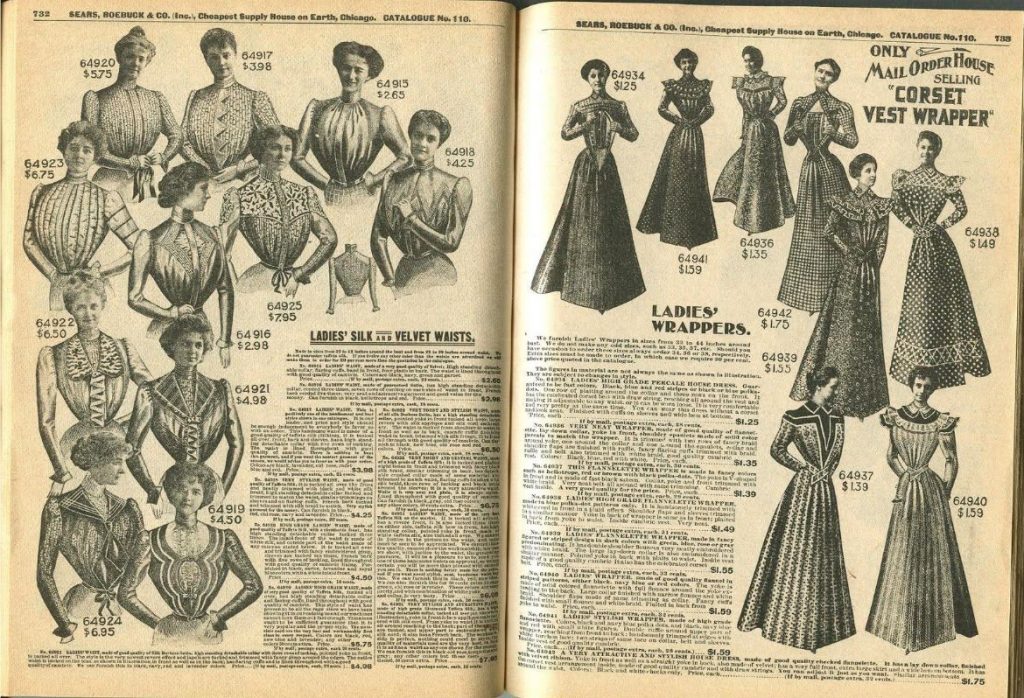
Mail-order catalogs made it possible to present clothes to consumers living far from major urban centers.
In the United States, Montgomery Ward launched its catalog in 1872.
Postal networks, improved transportation, and the proliferation of catalogs helped bring industrial fashion into homes far from big cities.
Photography, fashion illustrations, and magazines also played a growing role.
Clothing could now be seen before being purchased.
Fashion gradually became an industry of image as much as an industry of production.
8. READY-TO-WEAR TRANSFORMS SOCIETY
The birth of ready-to-wear was not only an industrial revolution.
It was also a social transformation.
By making certain clothes more accessible, industrial production helped broaden the number of people who could participate in fashion trends.
The Fashion Institute of Technology notes that the abundance of ready-made clothing contributed to a form of democratization of fashion in the 19th century.
However, this democratization remained relative.
Differences in quality, fabrics, finishing, cut, and price continued to distinguish social classes.
A mass-produced garment was not automatically synonymous with social equality.
Rather, it created a new possibility: accessing fashion without necessarily commissioning a unique piece from a tailor or dressmaker.
9. THE EARLY 20TH CENTURY: READY-TO-WEAR BECOMES A FULL INDUSTRY
By the early 20th century, ready-to-wear garment production was firmly established, particularly in the United States.
Department stores expanded their dedicated departments, and manufacturers produced clothes in various sizes.
Women also became a major clientele.
Evolving silhouettes facilitated this transformation.
Women’s clothing gradually became less restrictive. The 1910s and especially the 1920s saw the emergence of looser, uncorseted silhouettes.
In the 1920s, dresses were shorter, straighter, and looser. This less fitted silhouette particularly favored the growth of women’s ready-to-wear.
Fashion and industry were now working hand in hand.
10. THE 1920s–1930s: FASHION ENTERS THE AGE OF THE PRODUCT
An important step took place during the 1920s.
Ready-to-wear clothing was no longer presented solely as a practical and economical solution.
It began to be sold as a fashion product.
Department stores, magazines, and manufacturers gradually understood that consumers did not just want to be clothed.
They wanted to be fashionable.
This transformation was essential.
Ready-to-wear gradually ceased to be merely a garment manufacturing industry to become an industry of creation, communication, and desire.
In the 1920s, American department stores notably began working with designers and specialized departments. Clothes inspired by Parisian haute couture could be reproduced or adapted for a wider audience.
A new relationship emerged between:
creation → production → distribution → communication → consumption.
This is the fundamental structure of the modern fashion industry.
11. FROM HAUTE COUTURE TO READY-TO-WEAR
For a long time, haute couture and ready-to-wear were considered two separate worlds.
Haute couture represented unique garments, made for a specific client, and often associated with exceptional craftsmanship.
Ready-to-wear, on the other hand, represented the mass production of a single model across different sizes.
Yet this boundary was never completely airtight.
Couturiers gradually began working with industry, department stores, and manufacturers.
Ready-to-wear drew inspiration from haute couture, while haute couture sometimes adopted innovations born out of industrial production.
The Metropolitan Museum of Art describes these two systems today less as two completely separate worlds than as a continuum in which manual techniques and mechanized processes meet.
12. THE POST-WAR ERA: FASHION BECOMES A GLOBAL INDUSTRY
After World War II, ready-to-wear experienced renewed momentum.
Consumer society expanded.
Men and women had access to an increasingly vast selection of clothing.
Manufacturers, department stores, boutiques, and fashion houses developed new commercial strategies.
Clothing was no longer bought only out of necessity.
It became a product to be updated regularly.
This logic accompanied the rise of advertising, magazines, fashion photography, television, and later, cinema and popular culture.
Fashion thus became a system capable of rapidly diffusing trends.
13. THE 1960s: READY-TO-WEAR BECOMES CREATIVE
The 1960s marked a decisive turning point.
A new generation of consumers, particularly young people, challenged traditional fashion codes.
Mary Quant, Pierre Cardin, André Courrèges, and other designers participated in this transformation.
The Victoria and Albert Museum highlights that designers like Pierre Cardin, Emanuel Ungaro, and Yves Saint Laurent helped translate the aesthetic of couture into garments intended for everyday wear.
The boundary between luxury fashion and daily wear began to shift.
Ready-to-wear was no longer simply a cheaper version of couture.
It became a creative space in its own right.
14. 1966: YVES SAINT LAURENT AND THE CONSECRATION OF DESIGNER READY-TO-WEAR
One date is particularly significant in this history: 1966.
That year, Yves Saint Laurent launched his Rive Gauche line in Paris.
Maison Saint Laurent notes that this boutique offered a ready-to-wear line given a level of creative attention and energy previously reserved for haute couture.
The Metropolitan Museum of Art confirms that the Rive Gauche women’s line debuted in 1966, enabling Saint Laurent to reach a new group of consumers.
This was not the invention of ready-to-wear itself.
Ready-to-wear had existed since the 19th century.
What changed in the 1960s was its cultural and creative status.
Mass-produced clothing could now carry the signature of a major designer and become an object of desire comparable, in the imagination, to couture.
It was one of the great revolutions of modern fashion.
15. AFRICA ENTERS THE MODERN HISTORY OF READY-TO-WEAR
The history of ready-to-wear obviously did not stop in Europe and the United States.
In Africa, transformations in the textile and fashion industry followed multiple trajectories tied to local traditions, international trade, colonization, independence movements, industrialization, and exchanges with the diaspora.
In African cities, industrially manufactured garments and imported fabrics gradually coexisted with local systems of weaving, dyeing, tailoring, and garment making.
Department stores also contributed to spreading new forms of consumption in certain colonial cities.
A study published in the Journal of Design History highlights, for instance, the role of Kingsway stores in Accra and Lagos during the 20th century. These stores, modeled on European department stores, sold fabrics and clothing to a growing urban African clientele that included merchants, professionals, civil servants, and members of the urban middle class.
The development of modern African fashion cannot, however, be reduced to a simple adoption of European models.
African designers progressively transformed existing systems by combining textile heritage, contemporary cuts, and new production methods.
16. INDEPENDENCE: CLOTHING AS A TOOL FOR MODERNITY
African independence movements marked a major turning point.
From the late 1950s and particularly throughout the 1960s, clothing became a means of expressing sovereignty, modernity, and national identity in several countries.
Ghana gained independence in 1957.
Nigeria became independent in 1960.
In this context, designers began building modern fashions based on local textiles, silhouettes, and cultural references.
The journey of Shade Thomas-Fahm in Nigeria is particularly telling.
Returning to Lagos in 1960, she opened her boutique, Maison Shade, and developed clothes designed especially for cosmopolitan urban women. She worked with Nigerian textiles such as aso-òkè, adire, akwete, and okene, while adapting traditional garments to meet the needs of the modern woman.
For instance, she introduced a zipper into the ìró and created a pre-tied gèlè.
The underlying logic was deeply aligned with modern ready-to-wear: retaining a cultural anchor while adapting the garment to new uses and lifestyles.
17. CHEZ JULIE AND THE EMERGENCE OF MODERN AFRICAN FASHION
In Ghana, Juliana Norteye, known as Chez Julie, also played an important role in professionalizing fashion after independence.
Trained in Paris, she returned to Ghana in 1961 and developed an approach combining Ghanaian historical silhouettes with international trends.
Her creations, notably the kaba crafted using kente, illustrated this drive to transform clothing heritage into contemporary fashion.
The example of Chez Julie shows a fundamental shift.
African clothing was no longer viewed merely as traditional attire.
It became an object of design, commerce, creation, and contemporary identity.
18. AFRICAN TEXTILE INDUSTRIALIZATION
Following independence, several African nations sought to develop their own textile industries.
Local production was seen as a tool for economic growth and an affirmation of sovereignty.
Tanzania, for example, experienced significant expansion in its textile industry during the 1960s and 1970s. Five new textile mills opened between 1961 and 1968, while the Urafiki mill, inaugurated in 1968, became a major employer by the early 1970s.
Across the continent, the textile and apparel sector became a key industrial priority.
According to a UNESCO document, the textile and garment sector represented a major industrial activity in several African countries during the 1970s and 1980s. In 1984, Nigeria had 175 textile mills, while in Kenya during the 1970s, textiles ranked among the leading manufacturing sectors in terms of employment.
However, this industrialization later faced major obstacles.
Structural adjustment policies in the 1980s and 1990s, trade liberalization, and the massive influx of secondhand clothing and imported ready-to-wear severely disrupted many African textile industries.
19. FROM INDUSTRIAL READY-TO-WEAR TO AFRICAN READY-TO-WEAR
The contemporary history of African ready-to-wear is thus complex.
It is not simply a matter of replicating Western models.
African designers have utilized the principles of ready-to-wear—seasons, collections, sizing, retail, branding, and international distribution—while combining them with local craftsmanship.
Designers such as Chris Seydou in Mali, Kofi Ansah in Ghana, Shade Thomas-Fahm in Nigeria, Alphadi in Niger, Oumou Sy in Senegal, and Pathé’O have all contributed to building a contemporary African fashion scene with international visibility.
Ready-to-wear thus becomes a space where the following elements meet:
- Craftsmanship and industry
- Tradition and innovation
- Local production and global commerce
- National identity and global culture
- Africa and its diaspora
20. READY-TO-WEAR TODAY: A GLOBAL INDUSTRY
Today, ready-to-wear represents one of the primary systems for fashion distribution.
A collection can be designed in one capital, developed across several countries, manufactured on different continents, photographed for social media, and sold simultaneously across multiple markets.
The model has also evolved with the internet and e-commerce.
Consumers are no longer entirely dependent on department stores or physical boutiques.
Brands can directly reach an international audience.
For African designers, this evolution opens up new opportunities: selling from Lagos, Dakar, Accra, Johannesburg, Abidjan, or Nairobi to clients located on other continents.
Yet it also raises significant challenges: production capacity, financing, intellectual property, working conditions, reliance on imported raw materials, global competition, and the development of a viable local textile industry.
The contemporary challenge is no longer merely to create African fashion.
It is also to build the infrastructure capable of producing, distributing, and sustaining it in the long term.
21. WHAT THE HISTORY OF READY-TO-WEAR TELLS US ABOUT FASHION
The birth of ready-to-wear is often framed as a purely technical story.
In reality, it is much broader.
The sewing machine alone did not create ready-to-wear.
It required a combination of multiple transformations:
Industrialization + Standardization + Mass production + New retail spaces + Urbanization + Media growth + Evolving consumers.
Ready-to-wear in turn transformed society.
It altered our relationship to clothing, body image, consumption, and style.
Above all, it shifted a fundamental concept:
Fashion could now be designed for thousands of people at once.
And it was this ability to multiply a design that allowed fashion to become a global industry.
Ready-to-wear was not born on a single date.
It developed gradually over the course of the 19th century as industrial production, sewing machines, size standardization, department stores, and new distribution methods began working in tandem.
The 20th century gave it a new cultural dimension.
Through designers, magazines, advertising, and specialized boutiques, mass-produced clothing became a fashion product.
The 1960s cemented this transformation by turning ready-to-wear into a true arena for creative expression.
In Africa, national independence movements and the professionalization of local textile and fashion industries marked a new phase: reinterpreting regional heritage through contemporary modes of design and production.
Ultimately, the history of ready-to-wear is the journey from fashion designed for a select few to fashion capable of reaching millions—all while continuing to strike a balance between standardization and individuality.
TIMELINE
- 18th Century — British commercial establishments offer ready-to-sell garments alongside other merchandise.
- Late 1840s — The sewing machine becomes commercially available, drastically accelerating garment assembly.
- 1850s — Production of ready-to-wear men’s clothing expands significantly, particularly in the United States.
- 1863 — Ebenezer Butterick commercializes paper sewing patterns in standardized sizes.
- 1860s–1900s — Women’s ready-to-wear develops progressively: capes, undergarments, suits, shirts, and eventually dresses.
- 1872 — The Montgomery Ward catalog helps spur the growth of mail-order sales in the United States.
- 1920s — Ready-to-wear is increasingly marketed for its fashion qualities rather than solely for price or practicality.
- 1957–1960 — Independence in Ghana, Nigeria, and many other African states coincides with a new era of professionalization and recognition of African fashion.
- 1966 — Yves Saint Laurent launches Rive Gauche, conferring artistic legitimacy onto designer ready-to-wear.
DID YOU KNOW?
- Women’s ready-to-wear developed more slowly than men’s, largely due to the complexity of women’s garments and their close fit to the body.
- The sewing machine dramatically reduced the time required to manufacture a garment.
- Department stores played an essential role in spreading ready-to-wear clothing by presenting vast quantities of goods in a single space.
- Ready-to-wear did not begin with Yves Saint Laurent: the industry had existed since the 19th century. Saint Laurent primarily helped elevate designer ready-to-wear into a major creative discipline.
- In Africa, the era of independence fostered the rise of designers who combined local textiles, sartorial heritage, and international trends.
GLOSSARY
- Ready-to-Wear (Prêt-à-porter): Clothing manufactured in advance, in multiple copies and standardized sizes, to be sold directly to consumers.
- Custom / Bespoke (Sur-mesure): Garments made according to an individual’s specific measurements.
- Haute Couture: A design system based on individually made garments for clients, characterized by exceptional artisan craftsmanship.
- Standardization: The process of defining common measurements and procedures to produce multiple garments according to uniform benchmarks.
- Grading: The technical process of scaling a pattern up or down to produce different sizes.
- Garment Construction (Confection): The manufacturing of clothes by assembling various pieces of fabric.
- Department Store: A large-scale retail store bringing together multiple merchandise categories, offering a new urban shopping experience.
- Collection: A cohesive set of clothes and accessories designed around a season, period, or creative direction.
INSIGHTS FROM AFRIKASHION
The history of ready-to-wear serves as a reminder that fashion is never just about clothes. It relies on economic systems, technologies, urban growth, media, and social shifts. For understanding contemporary African fashion, this context is crucial: African designers have integrated modern collection, production, and distribution models while working with local textiles, techniques, and cultural references.
The journeys of Shade Thomas-Fahm in Nigeria and Chez Julie in Ghana show that African fashion modernity was not built on simple imitation. It was forged through adaptation, reinterpretation, and hybridization. Today’s true challenge lies in transcending the divide between tradition and modernity to build an African industry that converts its rich heritage into sustainable creative, economic, and cultural power.